Follow Us!
Lash Magazine
  • Home
  • Feminism
  • Pop Culture
  • College
  • Sex + Love
  • Art + Stories
  • Life + Wellness
  • About Us
    • Our Team
    • Contact Us
    • Legal
    • How to Submit

A Film About Disney NOT Made By Disney: 'Escape from Tomorrow'

10/29/2013

0 Comments

 
Picture
By Natalie Hamil, Staff Writer, Emerson College

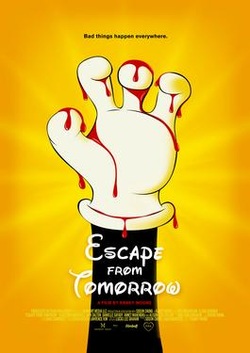
At the Sundance Film Festival 2013, a debut film from director Randy Moore premiered called Escape from Tomorrow. Seth Abramovitch from The Hollywood Reporter called the film a “micro-budgeted horror pic” and caused HitFix reporter Drew McWeeney to wonder, "How does this [film] exist?” The film takes place inside two Disney theme parks, and a majority of the film was actually shot there on location. But the most incredible part -- Disney had absolutely no idea that it was made.

Many people, including Emily Asher-Perrin from Tor.com, have called it “the ultimate guerilla film”. The film was shot using solely Canon 5D DSLR cameras. These cameras are small, normal cameras that tourists bring into the parks. They can take photos and shoot high quality video, so they were the perfect guerilla film cameras. The shooting locations were picked months in advance and scenes were extensively rehearsed outside of the parks so the film crew would shoot as few takes as possible. Sound was recorded either with digital recorders taped to each actor (which rolled all day) or on iPhones. Even though Escape from Tomorrow was actually in black and white, film times were extensively scouted to ensure that lighting would be suitable for each shot. The film was completed in about three weeks - 10 days in Walt Disney World in Orlando, Florida, and two weeks in Disneyland in Anaheim, California.

The film follows a father who was just told he was fired on his last day of a family vacation in Disney World, causing him to fall into a deep depression. Throughout the day, the father develops an unsuitable attraction to two teenage girls, hallucinates on rides, and becomes absorbed in his own imagination. The film is psychologically horrifying, messing with the minds of those who have visited the parks.

Perhaps the most shocking part of Escape from Tomorrow is that it was not discovered. The cast members at the parks rarely had a problem with the filmmakers, who only ran into security issues a few times, none of which seemed notable. The DSLR cameras and lack of normal film equipment made the film crew seem just like average tourists. Yet despite this, Moore edited the footage in South Korea hoping that Disney would not catch wind of it. He even refused to tell his closest friends what the project was about. The filmmakers refused to acknowledge which theme park was the setting for the film in advertisements for Sundance, and once it premiered, critics encouraged people to get to the screenings as quickly as possible before Disney’s legal team would shut down the project.

However, surprisingly, the film was not shut down – in fact, Disney’s legal team hasn’t said anything much about it. The trademarked music of “It’s a Small World” and a video from the “Soarin’” attraction were both removed from the film in advance to avoid Disney detection, but there are still hosts of opportunities for Disney to press charges that they are not taking. The Disney administration ingeniously understood that it was better to give no attention to the film at all, causing the film’s buzz to die down quickly. Escape from Tomorrow actually seemed to hoping that there would be a legal battle, which would cause a spike in popularity, so it will be interesting to see how the film does financially now that it has been released to the public.

As Drew McWeeny said in his HitFix article, “I would urge you to see [this film] now while you can. Who knows if it will ever be allowed to escape again?”

Image: Producers Distribution Agency


- Natalie Hamil is a Writing, Literature and Publishing major at Emerson College. She is on the pursuit of happiness. Her passions include reading, writing, crocheting and wearing interesting/colorful pants. Follow her on Twitter.

0 Comments

Why You Should Watch 'Masters of Sex'

10/29/2013

0 Comments

 
Picture
By Delilah Kaufman, Staff Writer, Emerson College
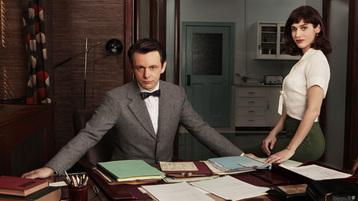
            Sex is great. Sex in movies is great. Sex on television is really, really great, (because maybe you’re like me and love the risk of your parents walking in and seeing people bumping uglies on the family television set). Of course, there’s a lot more to watching sex than just seeing pretty people have a good time - or in some scenarios, allowing yourself to have a good time too, and there’s a new series on Showtime that explores sex quite uniquely. Michelle Ashford’s Masters of Sex, adapted from Thomas Maier’s eponymous biography, explores the working relationship between Dr. William Masters and Virginia Johnson. the show is a dramatized adaptation of the lives of the first widely-renowned ‘sexologists’, starting from when Masters and Johnson first meet in the mid-1950s.    

            There were several things that drew me to the show, and admittedly, all the nudity and intercourse didn’t actually play a big part. Masters of Sex stars Emmy-nominated actor Michael Sheen and Lizzy Caplan, most notably known for her role as Janis Ian in Mean Girls. Already both well-respected actors in their own right (I loved Sheen’s performance in Frost/Nixon and Caplan in Starz’s Party Down, which sadly lasted only two seasons), Sheen stars as the series’s titular character, William Masters while Caplan shines as his second-in-command, Virginia Johnson. The series begins with Masters deviating away from his position in gynecology at Washington University in favor of researching human sexuality. Masters then hires Johnson, a recently divorced mother of two, who initially works as his secretary before becoming his research assistant. Masters dominates the screen as an educated but un-warm researcher, while Johnson, kind and personable, brings forth new ideas and helps him interact with their volunteers, who, by the second episode, turn out to be a harem of local prostitutes.

            It doesn’t take a genius to figure out that Masters of Sex is explicit, and for those scared easily by the human body, I should warn you that ten minutes don’t go by without a pair of bare breasts making themselves known. But unlike the gratuity of other shows on premium cable (HBO’s Game of Thrones, Showtime’s The Borgias), it’s all for good reason. In the show’s pilot, Caplan’s Johnson says to Sheen’s Masters, “[Having an orgasm is] like trying to describe salt to someone who’s never tasted salt.” Masters, slightly smug, seemingly all-knowing, replies, “I’ve tasted salt.” Johnson, of course, knows better: “Not the way I’ve tasted salt.”

            You can see how I fell in love instantly.

            Masters of Sex fits the aesthetic of a mid-twentieth century-set, Mad Men-reminiscent costume drama, while almost blatantly being tongue-in-cheek to all those shows that feature heavy sexual themes (there’s as many pairs of breasts in Masters of Sex as there are in Boardwalk Empire, but their appearances are made more suitably). What results is a poignantly dramatic, occasionally hilarious, portrait of the duo partially responsible for kickstarting the sexual revolution. Written almost exclusively by women, Masters of Sex is like a breath of fresh air - it’s racy, but balanced. What really makes the show is its resounding feminist themes, with the men being put in their place and the women - in a true Mad Men-like fashion - constantly outshining them. As Johnson smartly quips to a male colleague during a leisure evening of dancing, “[Sometimes] you just gotta show a man how it’s done,” and if Masters of Sex isn’t an example of television moving away from a slightly sexist and gratuitous standard, then I can only suggest you tune in yourself and see how exactly Masters and Johnson pave the way forward.

- Delilah Kaufman is a Writing for Film and Television major at Emerson College. Hailing from New York City, she is a cat enthusiast, addicted to Mad Men, and can fit her whole fist in her mouth. Follow her on Twitter.

0 Comments

In Defense of John Green: Why Ignoring Minorities Can Be A Good Thing

10/28/2013

8 Comments

 
Picture
By Megan Tripp, Staff Writer, Emerson College

If you follow John Green or Shailene Woodley on Instagram, or if you have an unhealthy obsession with Ansel Elgort – as most of the American population seems to – you’ll know that the filming of the movie adaptation of Green’s young adult novel The Fault in Our Stars began last month. John Green has suddenly been thrust into the Hollywood spotlight, and  Nerdfighters everywhere are rejoicing. However, there are some anonymous Internet users who have accused Green of narrow-mindedness. They claimed that he has an offensive lack of variation in his protagonists, and that he ignores his white, middle class, heterosexual privilege. However, he's actually doing just the opposite. 

Green is the author of four young adult novels: Looking For Alaska, An Abundance of Katherines, Paper Towns, and The Fault In Our Stars. He also co- authored a book with David Levithan entitled Will Grayson, Will Grayson. Four out of five of these books are narrated by a white, middle class, heterosexual boy. This pattern initially caused some to accuse Green of perpetuating the ‘Manic Pixie Dream Girl’ stereotype. The most publicly addressed accusation of this sort came in the form of a question submitted to Green’s Tumblr by an anonymous user about a month ago: 

"Hey John, I was just wondering what your explanation was for asserting yourself and appearing to be a very forward thinking writer and I guess general social rights advocate, but yet you heavily play into the troped ideal of what’s essentially the manic pixie dream girl, not to mention romanticizing extreme illness & suicide to your very young and definitely impressionable reader base?"

Green responded diplomatically, if passionately, and explained the plot for each of his books as what they are: a way to get his readers to think about people as complicated human beings and not as stereotypes. As he puts it, “I do not know how I could have been less ambiguous about [the importance of breaking down stereotypes] without calling the novel The Patriarchal Lie of the Manic Pixie Dream Girl Must Be Stabbed in the Heart and Killed.”

I will agree with the anonymous Tumblr user to a point. John Green has a formidable web presence and considerable international influence on young adults, which is why such accusations against him are so preposterous. In fact, Green’s novels, and most of his Vlogbrothers videos deal with “imagining people more complexly,” to quote Green himself in his Tumblr response. Almost everything he discusses in his books and on his many YouTube channels urge his audience to look at people as complex human beings as opposed to cardboard cutouts of idealized stereotypes. This is an important message for everyone to remember, especially young adults, which is why I’m such an avid fan of Green. This particular Tumblr user is likely uninformed and has possibly never read one of Green’s books -- or has done so without taking them seriously. 

Green’s novel, Paper Towns, is essentially a record of the narrator’s journey to find Margo, the girl he has idealized since childhood. She disappears and he takes it upon himself to find her and “save” her, which is a desire mostly motivated by his need to understand her mysterious personality. However, at the end of the novel, Green makes it very clear that Margo doesn’t need to be found, or saved. In truth, the narrator’s obsession with Margo was really an obsession with what he wanted her to be, not with the person she truly is. Clearly, Green is using his books to smash down the Manic Pixie Dream Girl trope, not to add to the hefty canon of literature that spotlights this persona. 

Other Internet users have similarly accused Green of writing from a single point of view: that of a privileged, middle class white male. He addressed this briefly in a few of his YouTube videos, yet I think the defense for this particular accusation is pretty clear. Green is a privileged white male. Thus, he has no other perspective from which to draw for his writing. It’s understandable that he doesn’t write about the struggles of a gay teenager, or an African American teenager, or a trans teenager because he doesn’t identify with any of these labels. Some of his readers would find his attempts to write a story about an angst-ridden Chinese trans woman incredibly presumptuous because he has no frame of reference for that particular human experience. In fact, that could be seen as even more offensive for him to attempt to do that, than to keep with his current method. 

Young adult (YA) novels mostly attempt to capture relevant moments in young adult life that readers in that age group will enjoy reading about. YA fiction is an ever-expanding genre that covers a wide range of races, ethnicities, religions, gender identities, and sexual orientations. John Green represents one of these types of people in his fiction; it simply happens to be the majority that he is representing. It’s frankly not his fault that he was born a white, heterosexual man from a middle class family. Let’s all take a step back and, as Green would put it, try to “imagine him a little more complexly.”

Image: Penguin Group

- Megan Tripp is a senior Writing, Literature, and Publishing major at Emerson College. When she's not writing, she drinks copious anounts of coffee, watches Netflix, and thinks about what she wants to write next. Contact Megan on Twitter.

8 Comments

HATERS GET MAD: SOULJA BOY THE GREATEST RAPPER OF ALL TIME

10/24/2013

0 Comments

 
By Kevin O'Brien, Staff Writer, Emerson College
Picture
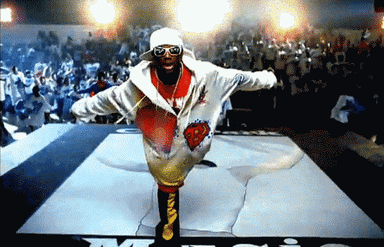
“Who is Soulja Boy and what in the heck is that dance?” is the question the savvy businessman asked in the beginning of Soulja Boy’s “Crank That” video. It was the last time the question was ever asked again. Soon enough, the dance and song became an international internet sensation, and it was impossible to go to any middle school dance without seeing rows of kids jump around aimlessly to “superman that ho.” Before the song’s then sixteen-year-old creator, DeAndre Cortez Way knew it, “Crank That” had become the first single to sell 3 million digital copies and teachers and parents were humming it everywhere after hearing it constantly from the ringtones of children around them. It was a fun, harmless song that ultimately didn’t “kill” hip-hop as cynical and stuck up critics predicted it would - though it is still written off as a one hit wonder. Soulja Boy has become somewhat of an inside joke within the hip hop community, and the mere mention of his name is immediately met with a smirk and shifty eyes, but what people don’t realize is the massive impact that Soulja Boy had on hip hop and music and general. Soulja Boy’s influence is undeniable, and whether you like him or not, it is ignorant to ignore his key role in shaping the modern state of music, and hip hop in particular.

Soulja Boy’s insane popularity is due almost exclusively to his use of the Internet and YouTube as his distribution method. Soulja Boy, a kid himself at the time, clearly understood how his generation was spending their time and where they were consuming media. Soulja Boy’s “Crank That” was a song that was majorly successful as a product of the Internet, and the way he pioneered the use of this platform forever changed the way people listen to and distribute music. Now, there is no hugely popular song, or any song for that matter, that doesn’t owe whatever success it has largely to the internet. Music and the Internet have become inseparable, and Soulja Boy was the kid who spilled the glue that joined them in the first place, regardless of how sloppy the seal was. 

“Crank That” is the godfather track to a long lineage of 21st century meme dances. This is a simple dance that presents a catchy pop-rap song through a fun and accessible video that is distributed through the Internet. Meme dances are hugely popular for a few weeks, but are soon forced to live the rest of eternity in the dark crevasses of the Internet with the likes of the “Bedroom Intruder” and that song about the fox or whatever. In an attempt to ride the coattails of the success of “Crank That,” dance songs identical in sentiment began sprouting up of nowhere, some more successful than others. Notable examples include “You’re a Jerk," "Teach Me How To Dougie," “Cooking,” (We’ll get to Lil B later), and more recent examples like “Gas Pedal."

From the beginning, Soulja Boy emerged as an interesting figure in the hyper-masculine hip-hop community. He danced, his beats were childlike, he wore colorful Bathing Ape Shoes, wrote his name on his sunglasses, and called himself “pretty." He was like the pack of bubble gum that found its way next to the condoms in CVS. Hip-hop is often criticized for the artists’ excessive assertion of masculinity, and in turn, its violent and misogynistic content, while Soulja Boy was always too busy trying to find the switch to turn his swag on or getting kisses through the phone. While Rich Boy was trying to get D’s thrown on his new Caddy, Soulja was trying to get some D’s thrown on his report card. Rappers have become more in touch with their feminine sides. As much of a “pretty mothafucka” A$ap Rocky may appear to be now, he definitely wouldn’t be as proud of it if Soulja hadn’t shown us his own signature “pretty boy swag” years before “Peso.” Soulja Boy’s total disregard for expectations of what a rap star should be and his focus on individuality opened the doors for future artist to be equally or more expressive and flamboyant. Its hard to imagine queer rap artists such as Mykki Blanco and Zebra Katz being accepted by such large audiences without Soulja Boy setting the groundwork for expressive and flamboyant music.  

A lot of people ask me to explain what “Based” means in reference to transcendental meme-rap icon Lil B. Although it is an increasingly abstract concept that enters Camus and Kierkegaardian levels of philosophical complexity, its basic definition is to be oneself in a way that disregards societal expectations, and to do nothing that hinders anyone from doing the same. This philosophy is manifested through the music of Lil B and other artists with a similar stream of conscious, comically absurd lyricism. It is essentially self-aware, bad rapping. Soulja Boy was doing this years before Lil B and his contemporaries. His raps were always fun, easy-going, lyrical nonsense that had no intention of appealing explicitly on an intellectual level. While Lil B may be responsible and have coined the Based movement, Soulja Boy was the first to express these ideas in his music. Lil B is the Vladimir Lenin to Soulja Boy’s Karl Marx. Not to mention Soulja was swaggin way before every fourteen year old boy at the strip mall stripped the word of its meaning.

Soulja Boy doesn’t make it easy for any serious music listener to like him, and that’s fine, you don’t have to like him. In fact, it is entirely acceptable to dismiss Soulja Boy as garbage. However, there were a lot of bad people who did objectively influential things, and it is important to recognize this influence to understand the greater context of their impact. When hip hop history is studied in classrooms across the world, Soulja Boy is going to get one of those special sectioned off blue sections with a picture of him glaring at us past the page, past his name written on his shades.

Kevin O’Brien is a New Jersey native who is studying film production at Emerson College. He is a Pitchfork Historian, accomplished musician, and aspiring Internet celebrity. Girls love him, boys want to be him, you’re just jealous because he’s famous. You can find Kevin on Twitter (in fact, he insists you do).

Image: Uproxx

0 Comments

BANKSY HANDS NEW YORK A QUESTION MARK

10/18/2013

1 Comment

 
By Maggie Ambrose, Section Editor, Emerson College
Picture
Graffiti done by Banksy
On Saturday morning, an unassuming, unidentified old man set up a stand selling signed original Banksy spray art prints for $60 each in Central Park, New York.

The stand was up and running at eleven in the morning, yet the first purchase was not made until three-thirty. An American woman purchased two small prints for her children, but only after haggling the price down to half. Half an hour later, a woman from New Zealand purchased two prints. At five-thirty, a man from Chicago purchased four prints, explaining, “I just need something for the walls.”

The day’s grand total for these eight prints was $420. Conservatively, these eight prints could have sold for $30,000 each.

Banksy has been spending a month in New York where he means to make one piece of street art each day of October, and has titled the project Better Out Than In. The artist elaborates on his residency in a meticulously secret interview with New York’s publication The Village Voice. “The plan is to live here, react to things, see the sights - and paint of them. Some of it will be pretty elaborate, and some will just be a scrawl on a toilet wall.”

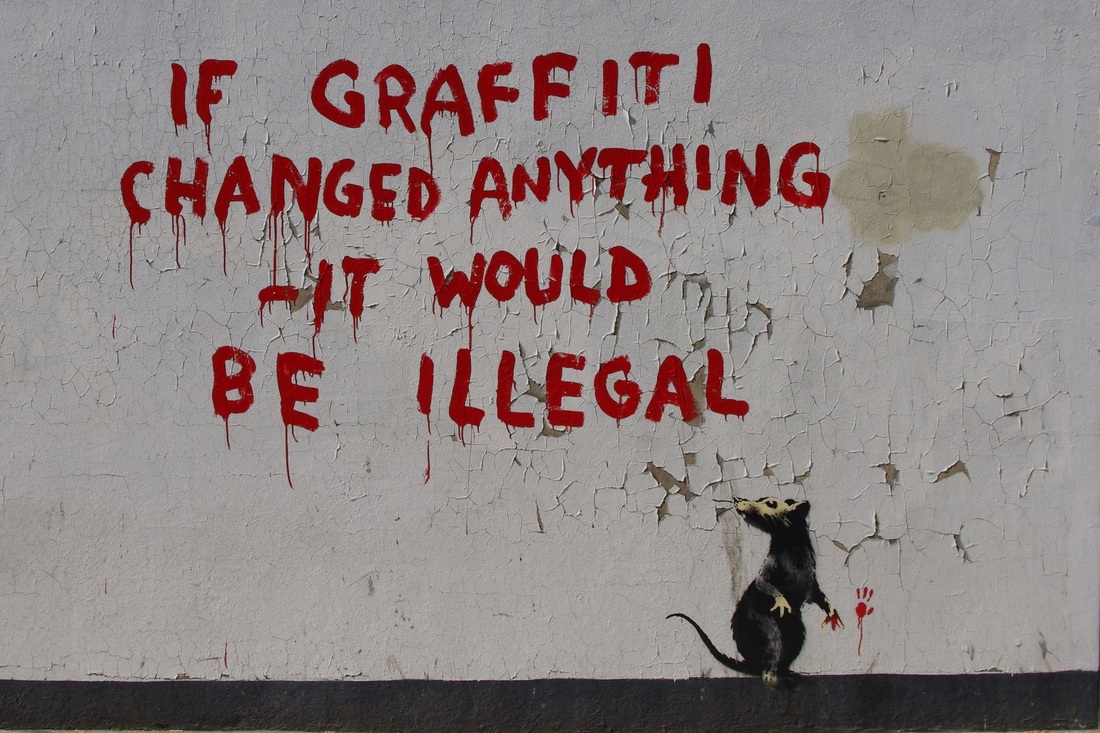
On October 1st, a Banksy spray art appeared in Chinatown displaying two old-school paperboys in overalls reaching for a spray paint can from a street sign that reads ‘Graffiti Is A Crime’. The piece also included a stenciled telephone number that viewers could call to learn more about the piece. Banksy posts these recordings online on his newly wiped website, http://www.banksy.co.uk/. The Chinatown post, which has since been titled The Street Is In Play, introduces Banksy’s motive.

A voice articulates over ominous elevator music: “Hello, and welcome to Lower Manhattan. Before you, you will see a spray art by the artist Banksy. Or maybe not. It’s probably been painted over by now. If, however, you can still make it out, you are looking at a type of picture called graffiti - from the Latin graffito - which means graffiti, with an ‘o.’ The child, in this case, represents youth and the sign represents, well, signs.” The voice goes on to discuss technical artistic terms and Banksy’s supposed vision in ornate language. After awhile, the voice abruptly cuts into colloquialisms, inquiring, “Are you kidding me? Who writes this stuff, anyway? You decide. Really, please do. I have no idea.”

It is up to us to make sense of October 11th’s The Sirens of the Lambs, a staged slaughterhouse delivery truck that drove around the Meatpacking District and featured twitching, squealing plush farm animals sticking out the truck’s sides. It is up to us to truly see the art displayed in street stands, because there might be something Banksy knows we’re missing.
I couldn’t be more excited for October. 

 Maggie Ambrose studies English at Emerson College. She is a big fan of velvet, tomatoes, thank you notes, and New Jersey.
Image: http://news.fitzrovia.org.uk/
1 Comment

Review: Blue Is the Warmest Color

10/13/2013

0 Comments

 
By Delilah Kaufman, Staff Writer, Emerson College 
Picture
Left: graphic novel, right: film adaptation
When I heard the Palme d’Or at this year’s Cannes Film Festival was given to a graphic novel adaptation, I did what I always do: begged my mom for her credit card, logged on to Amazon, and sought to buy the book. Which didn’t happen, by the way. Blue Is the Warmest Color had yet to be released in its English translation - that would happen in October. That meant doing the American thing by moaning about waiting for both to come out. What else can I say? I was truly intrigued and as always, wanted to submerge myself in French culture. It probably helps to mention some of the anticipation came with both the movie and the graphic novel being about lesbians.

Do you see where I’m going with this?

Blue Is the Warmest Color, published originally in 2010 by Julie Maroh, is a love story, a tragedy, and a work of art rolled into one. It was released two months early in August to cater to English-speaking audiences, and I bought the translation the day it came out, devouring it within a few hours. Three weeks and a second read-through later, I’m still reeling.

Blue chronicles the relationship between Clémentine and Emma, two young women living in France at the turn of the new millennium. Clémentine, a naïve high schooler, is boy-crazy and unknowing. A chance encounter with a blue-haired college student named Emma leaves Clémentine questioning her sexuality and all that she has ever known. The result is a story more poignant than any Oscar-winning drama in recent years.

This might sound ridiculous—but there is a reason why the film adaptation won at Cannes this year, and it all started with the graphic novel. Maybe it’s the way Maroh carries Clémentine’s story from beginning to end, or how her art—schemed in black and white, with blue only appearing to accent Emma’s hair and presence— makes Blue Is the Warmest Color more than your typical coming-of-age story. However, that isn’t to say Blue exists without cliché. To be frank, Clémentine’s sexual awakening is akin to almost every other story I’ve read that deals with same-sex relationships. What saves it is the way Maroh allows the story to be explicit and ugly, in every realistic way possible, be it through dialogue, Clémentine’s diary, and even the art itself.

At the very least, Blue Is the Warmest Color is something worth checking out because it’s something you will hear about. The film adaptation has received some serious buzz and even some controversy; staying true to the graphic novel, the movie is explicit and heavy on the sexual content. Depending on who you are, this may or may not be a good thing. However, I’m a firm believer in not skimping out on reality, and Blue in all its rawness is exactly that: honest, driven, and absolutely beautiful. You will fall for its characters, its art, and you will stick with its story to the very end—whether you like it or not.

Delilah Kaufman is a Writing for Film and Television major at Emerson College. Hailing from New York City, she is a cat enthusiast, addicted to Mad Men, and can fit her whole fist in her mouth. You can find Delilah on Twitter.
0 Comments

Destruction in Disguise: Why We Have to Stop Using Spotify

10/12/2013

6 Comments

 
By Kevin O'Brien, Staff Writer, Emerson College 
Picture
Daniel Ek, CEO and Co-founder of Spotify (source: Corbis)
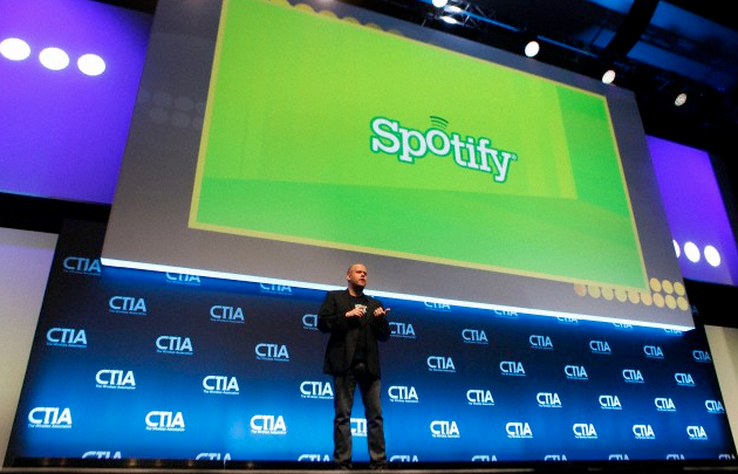
It has become common knowledge that artists get paid very little for having their music played through online music streaming and radio services such as Spotify and Pandora. According to Galaxie 500 member Damon Krukowski’s article “Making Cents” on Pitchfork, he and his two other band members received a collective $1.05 for the 5,960 times their song “Tugboat” was streamed on Spotify. That is in the rare instance where the songwriters have 100% of their rights and royalties. “I have simply stopped looking to these business models to do anything for me financially as a musician,” writes Krukowski. It’s comforting to know that certain artists have come to accept what these services do (or don’t do) for their place in the music industry. What we ignore, however, is how these online listening services negatively affect the musical experience of the consumer as well.

 Access to the vast majority of recorded sound all in one database is definitely incredible, but it comes with a downside that people too quickly dismiss as a minor inconvenience - the commercials. While the commercials may seem trivial, they actually cause a significant detriment to the listening experience. There is a certain magic intended by the artist in listening to an entire album front to back, uninterrupted. In my opinion, this is the only way to listen to music, because any other way doesn’t provide the full experience. A few commercial interruptions take enough away from the intended experience for me to stop using Spotify to listen to albums altogether.

Spotify ruins the immersive album experience and distorts the traditional way we listen to music in general. Take Boards of Canada’s latest release, Tomorrow’s Harvest, for example. The duo is famous for meticulously crafting soundscapes evocative of landscapes - and their latest release is no different. Hearing a commercial during Tomorrow’s Harvest is like walking alone on the moon of an undiscovered planet, light-years away from society, only to look up to see a giant billboard advertising $1 Whopper Juniors. It’s a real bummer to be reminded of the world from which you’re trying to escape just as it starts to fade in the distance.
Picture
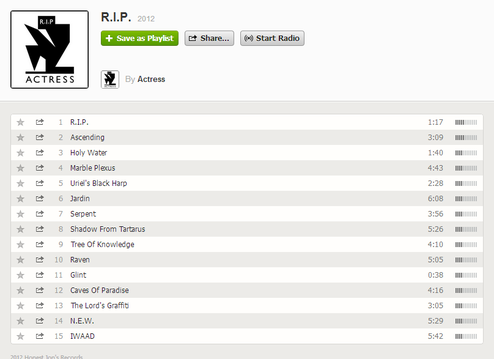
Another album that just don’t quite click unless listened to fully, uninterrupted is Actress’ R.I.P. R.I.P can be a transcendental listening experience, a semi-conscious sonic exploration of the space in-between life and death. For some listeners, it can seem off-putting for its lack of rhythm. However, Actress’ rhythm isn’t found within percussion in each song individually, but rather in the pulse of the album as a whole. If the album is constantly being interrupted by a Spotify commercial in which Johnny Knoxville shouts at me to watch him dress up as an old man and make an ass of himself in his new film cleverly titled Bad Grandpa, a listener could never find that pulse, and it wouldn’t be the same album. Think about how Kendrick would feel next time a commercial for St. Jude’s Children’s Hospital comes on after you finish listening to “Bitch, Don’t Kill My Vibe”.

Artists put a lot of thought, energy, and creativity into what emotions they wish to conjure up for their listeners. When their music is streamed on Spotify, none of these emotions can be fully realized as they often compete with a lingering feeling frequent Spotify use can give you - anxiety. Towards the end of a song streaming on Spotify, I become so fixated on the anticipation of a commercial, and so anxious about whether or not the next song will play uninterrupted, that I subconsciously reject any other emotion that the song may intend for me to experience. The feeling is a lot like that of traveling through a cave in a Pokémon game without having used a repel beforehand. With each step comes the crippling anxiety of not knowing whether a wild Zubat will interrupt your journey or not. The only difference is that a Zubat is sort of cute and can evolve into the much superior Golbat, while Spotify commercials can only evolve you into a version of yourself with less money, less interest in the music you were listening to before, and an ugly dent in the mood you were trying to create with whatever music you put on.

Trying to give music listening a social platform by connecting Spotify to Facebook is truly a progressive concept. People identify with music and want other people to know what they’re listening to - this is why people have band shirts and record collections prominently displayed where they live. Back when I peaked in 8th-9th grade and girls would constantly add me on Myspace, I would determine if they were suitable mates in an instant by clicking on their pages and hearing their Myspace songs. If you were bumping NeverShoutNever, sorry girl. But if I clicked on your page and I heard some Shins or some OLD SCHOOL Jimmy Eat World, then hay mayb u got a comment on ur pic ;). This resonated with people because they were able to select what music they wanted others to think they were listening to, while they were then able to listen to whatever they truly wanted to in private. 

Theproblem with Spotify is that there is no separation between the private and the public, which makes for self-conscious, inauthentic music listening. I’m sure people could argue that they are proud of what they listen to and are never ashamed of people seeing it, but the knowledge that whatever you listen to is going to be publicly broadcasted does affect what you choose to listen to - whether consciously or not. Music, once an experience that allowed us to reconnect with ourselves privately, has just become another charade that is used to reinforce the character we present ourselves to be to others. Maybe you really aren’t embarrassed by what you listen to, but the fact that you can never listen to it truly alone makes it almost impossible to create any sort of intimate bond with music.

The main problem that Spotify presents is that it takes sound that is produced in a traditional format, and distributes it in a non-traditional, modern way. This creates an imbalance and a dissonance that disturbs musical consumption and hinders listeners from reaching full potential enjoyment. People should listen to music in a way that compliments the manner in which it was produced. So, while there’s nothing inherently wrong with how Spotify makes us consume music, the problem arises when we are listening to music intended for an ad-free, singular listening experience. Until an artist comes out with music that is complimented by the way Spotify broadcasts music, I wouldn’t sacrifice the experience of listening for convenience.

Kevin O’Brien is a New Jersey native who is studying film production at Emerson College. He is a Pitchfork Historian, accomplished musician, and aspiring Internet celebrity. Girls love him, boys want to be him, you’re just jealous because he’s famous. You can find Kevin on Twitter (in fact, he insists you do).

6 Comments

Review: Blue Is the Warmest Color

10/12/2013

0 Comments

 
Delilah Kaufman, Staff Writer, Emerson College 
Picture
Right: graphic novel adaptation. Left: film adaptation
When I heard the Palme d’Or at this year’s Cannes Film Festival was given to a graphic novel adaptation, I did what I always do: begged my mom for her credit card, logged on to Amazon, and sought to buy the book. Which didn’t happen, by the way. Blue Is the Warmest Color had yet to be released in its English translation - that would happen in October. That meant doing the American thing by moaning about waiting for both to come out. What else can I say? I was truly intrigued and, as always, wanted to submerge myself in French culture. It probably helps to mention some of the anticipation came with both the movie and the graphic novel being about lesbians.

Do you see where I’m going with this?

Blue Is the Warmest Color, published originally in 2010 by Julie Maroh, is a love story, a tragedy, and a work of art rolled into one. It was released two months early in August to cater to English-speaking audiences, and I bought the translation the day it came out, devouring it within a few hours. Three weeks and a second read-through later, I’m still reeling.

Blue chronicles the relationship between Clémentine and Emma, two young women living in France at the turn of the new millennium. Clémentine, a naïve high schooler, is boy-crazy and unknowing. A chance encounter with a blue-haired college student named Emma leaves Clémentine questioning her sexuality and all that she has ever known. The result is a story more poignant than any Oscar-winning drama in recent years.

This might sound ridiculous—but there is a reason why the film adaptation won at Cannes this year, and it all started with the graphic novel. Maybe it’s the way Maroh carries Clémentine’s story from beginning to end, or how her art—schemed in black and white, with blue only appearing to accent Emma’s hair and presence— makes Blue Is the Warmest Color more than your typical coming-of-age story. However, that isn’t to say Blue exists without cliché. To be frank, Clémentine’s sexual awakening is akin to almost every other story I’ve read that deals with same-sex relationships. What saves it is the way Maroh allows the story to be explicit and ugly, in every realistic way possible, be it through dialogue, Clémentine’s diary, and even the art itself.

At the very least, Blue Is the Warmest Color is something worth checking out because it’s something you will hear about. The film adaptation has received some serious buzz and even some controversy; staying true to the graphic novel, the movie is explicit and heavy on the sexual content. Depending on who you are, this may or may not be a good thing. However, I’m a firm believer in not skimping out on reality, and Blue in all its rawness is exactly that: honest, driven, and absolutely beautiful. You will fall for its characters, its art, and you will stick with its story to the very end—whether you like it or not.

Delilah Kaufman is a Writing for Film and Television major at Emerson College. Hailing from New York City, she is a cat enthusiast, addicted to Mad Men, and can fit her whole fist in her mouth. You can find Delilah on Twitter.
0 Comments

High in Space: A Stoner's Review of Gravity

10/10/2013

1 Comment

 
By Anonymous, Staff Writer, Emerson College

Last Friday a couple of buddies and I went to go see the movie Gravity, directed by Alfonso Cuarón. It was playing in 3D and IMAX and we decided it would be a fun idea to get really fucking high before the movie since stoners can’t get enough of the beauty that is space. So, after smoking a handful of joints and bowls, we ventured over to the theater. The movie was an amazing experience and I’d recommend it to anyone, whether you’re sober or if high as space itself. Here are the top 25 high-as-fuck thoughts I had during Gravity.
  1. Shieeett.
  2. Fuck Clooney’s country music
  3. Of course the Indian dude went to Harvard and is a party animal and dies first.
  4. What would Neil Degrasse Tyson think?
Picture
5. What would Neil Armstrong do?
6. Wait, does anyone else think George Clooney is the human version of Buzz Lightyear?!?
7. Because he is.
8. What would Neil Patrick Harris do?
9. George would hit on Sandra in space.
10. Clooney gotta shut da fuck up and not ask Sandra if she thinks he's attractive when her oxygen is only at 2%.
11. Now is not the time Casanova.
12. How funny would a Wayan’s brother version of this movie be.
13. Or a Tyler Perry movie... "Madea Goes to Space."
14. Sandra bullock moans seductively all the fucking time, whyyyy...
15. I wonder what George is thinking about, I’d think about sea otters. In space. Sea otters in soace.
16. What if he has to pee?
17. HOLD UP. Where are the MonStars from Space Jam?
18. Rando Chinese dude with dog and a baby who is singing a lullaby is talking over the mic to Sandra in the space pod...whatttttt?
19. WTF is this shit, what the shit is going on with this random Chinese guy.
20. How does he have Sandra’s number?
21. Seriously how da fuck did this Chinese dude find a way to talk to Sandra in space.
22.Why does that pen float some damn much, it’s been floating in like 5 different scenes.
21. So after Sandra escapes back to earth is that when she adopts/kidnaps the football player from The Blind Side and develops an accent or....?
22. I want Chinese food.
23. Sandra must have breathed in more smoke in the shuttle than Wiz does in a week.

Picture
24.Yo fucking take the space suit off before getting out of the pod, Miss Congeniality.
25. I always wonder why I stopped wanting to be an astronaut. I shall never wonder again.

And now, for a brief quote from my friend who did not like the movie. 

“The only gravity I felt was towards the exit.”

images: Tumblr

1 Comment

Has the King Lost His Touch? - Doctor Sleep Review

10/8/2013

1 Comment

 
PictureThe King
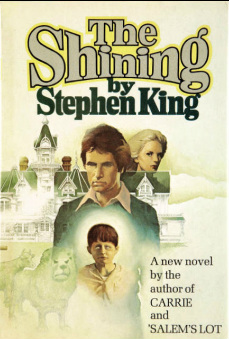
Stephen King’s The Shining scared a generation witless.  The twisted proclivity for gory details of the bestselling novel left readers everywhere hanging on to his every written word. Naturally, when the sequel was announced, King fans everywhere were simultaneously excited and apprehensive. Can such success really be recreated in a sequel, even if the author’s name is King? Unfortunately, after completing the novel in the early hours this past Wednesday morning, I must admit I don’t think King pulled it off. 

King has always carefully treaded the thin line between pop fiction – the kind you pick up at the airport to put you to sleep on a flight – and true horror. There are definitely market-driven flashes of pop fiction in all of his books, but they mostly get overshadowed by the more intriguing elements of his dark humor and even darker imagination for creepy crawly nightmares. Doctor Sleep, however, is a step toward King falling over the edge into complete pop fiction. 

It’s a great premise: Danny, the little boy from the Overlook Hotel who has a touch of “the shine” (the special blessing/curse that allows him to read minds and see people who are no longer living but aren't quite dead yet) is all grown up now. Doctor Sleep picks up a few years after the disaster at the Overlook and Danny continues to see the slimy creepy crawly corpses he used to see during that winter at the hotel. His mother, Wendy, calls in Dick Hallorann, the chef from the Overlook, who acts as Danny’s mentor when it comes to all things “shine.” Dick imparts some special wisdom about controlling the shine and King plants the seed for the rest of the plot. 

Danny, who goes by Dan as an adult, struggles with alcoholism as he ages because alcohol muffles the shine that he has come to resent. King’s own rocky journey with alcohol and drug abuse peeks through not-so-subtly in the descriptions of Dan’s “rock bottom” scene and his experiences in AA.

Meanwhile, our other main character is born nearby. Abra, as in “cadabra” King points out, is a little girl with even more shine than Dan – one of the most powerful shines anyone has ever seen. As an infant, Abra predicts the 9/11 attacks and tries to warn her parents via disturbing dreams and hours of screaming. And that’s just the beginning.
PicturePrequel to Doctor Sleep
Our two main characters don’t actually meet until almost two hundred pages into the story, which perhaps is a testament to that fact that as you become as successful an author as King, your editor does less and less editing. When the two characters finally come together, it’s to join forces against the villain of our story: the True Knot. The Knot is a group of semi-immortal non-humans who feed on the “steam” that kids with the shine produce as they die. And, in a brilliant stroke of famous King dark humor, these villains take the form of unassuming RV travelers. That’s right; King managed to make clowns terrifying in It, dogs the stuff of nightmares in Cudjo, and made you fear the quiet girl at the back of high school math class with Carrie. Now he’s making you suspicious of every sweet-looking, over-the-hump, RV owner sporting a “World’s Greatest Grandma” T-shirt. 

Dan and Abra must embark on a grand journey to eradicate the Knot because, in true villain form, the Knot won’t stop until they’ve been killed. Overall, the story is engaging and Dan is a deliciously flawed but lovable protagonist. And as always, King captures the essence of his kid characters spectacularly well. King returns to his common theme of family in this book as well; however, a random, unnecessary familial tie is where King lost me completely and took the plunge over the precarious pop fiction edge. 

About half way through Doctor Sleep, King falls into the trap that frustrates readers to no end- keeping them out of the loop. Common in crime novels, this tactic is full of clandestine meetings that the reader is not privy to. It includes lots of summarized dialogue that tells us how characters are laying out intricate plans to catch the bad guys, but don’t let readers in on it. The significant difference between pop fiction crime paperbacks and Doctor Sleep is that King employs this infuriating method for about three hundred pages – the size of a small novel itself. Personally, I resorted to gritting my teeth and bearing with him, simply because of the credibility King already has.

But once the plan is revealed, if you've read The Green Mile, you’ll recognize Dan’s kill shot as a technique taken directly from John Coffey’s playbook. Is Mr. King recycling plot devices? You tell me. 

All of these aspects combined with a few extremely recent cultural references – one member of the Knot threatens one of Dan and Abra’s friends; to “kill him as dead as Amy Winehouse” – that seemed like desperate attempts to stay relevant, made this book grate on my Stephen King-loving nerves a little. 

I did wonder multiple times why King pushed back the release date from January to September of this year for “revisions” and if these revisions were really just 200 extra pages – nevertheless, I enjoyed it as I always enjoy King’s work.

If you’ve read The Shining and are curious about Dan’s fate and this new super-shine preteen girl, I suggest picking this one up. It's possible that I set my expectations a little to high for King to meet, but that doesn't mean Doctor Sleep isn’t a great read.

The one thing I missed most was the lingering sense of being haunted. I wasn't scared to close my eyes and see The Knot like I was scared to turn corners in dark hallways for fear of The Shining’s Jack Torrance. Although, to his credit, I’ll never be able to look at my grandparent’s RV club the same way.

Megan Tripp is a senior Writing, Literature, and Publishing major at Emerson College. When she's not writing, she drinks copious anounts of coffee, watches Netflix, and thinks about what she wants to write next. Contact Megan on Twitter.

Images: Newsbusters, Wikipedia 

1 Comment
<<Previous

    Archives

    March 2015
    December 2014
    November 2014
    October 2014
    April 2014
    March 2014
    February 2014
    January 2014
    December 2013
    November 2013
    October 2013
    September 2013
    August 2013
    July 2013
    May 2013
    April 2013
    March 2013
    February 2013
    January 2013

Powered by Create your own unique website with customizable templates.
Photo from Tisha M.